
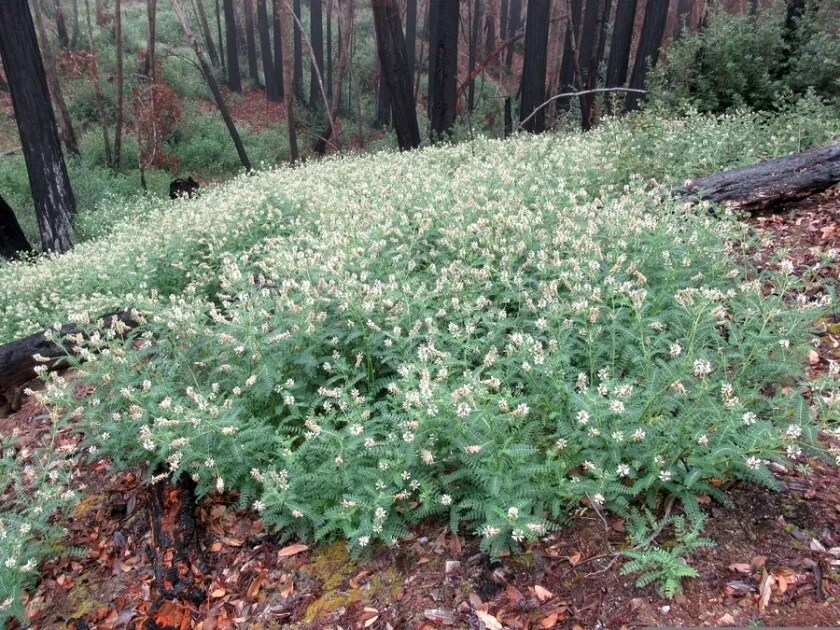
Dean Lyons was mushroom-hunting in the Santa Cruz Mountains last spring when he came across what he thought, at first, was a huge patch of weeds.
Lyons, a hobby naturalist, snapped pictures and posted them on a wildlife mapping and identification platform called iNaturalist, hoping botanists would weigh in to identify the species.
Experts on the app suggested that it might be Humboldt County milkvetch (Astragalus agnicidus), an endangered plant that had never been seen south of Mendocino County.
Dylan Neubauer, a local botanist and rare-plant expert, hiked to the site and confirmed the identification, photographing the distinct red, hairy fruit pods. She and Lyons published an article about the discovery in the California Botanical Society’s journal, Madroño, in March, detailing the fraught history of this struggling plant.
Humboldt County milkvetch is known as a fire-following plant, one that primarily appears after a great disturbance, such as a timber harvest or fire. Botanists believe that its emergence in Santa Cruz County, 155 miles south of its native habitat, is directly tied to the 2020 CZU Lightning Complex fire and that Lyons’ discovery offers a window into how the landscape has been reshaped as forestry practices have shifted from regular burning to intense fire suppression.
…
 ALIX SOLIMAN