
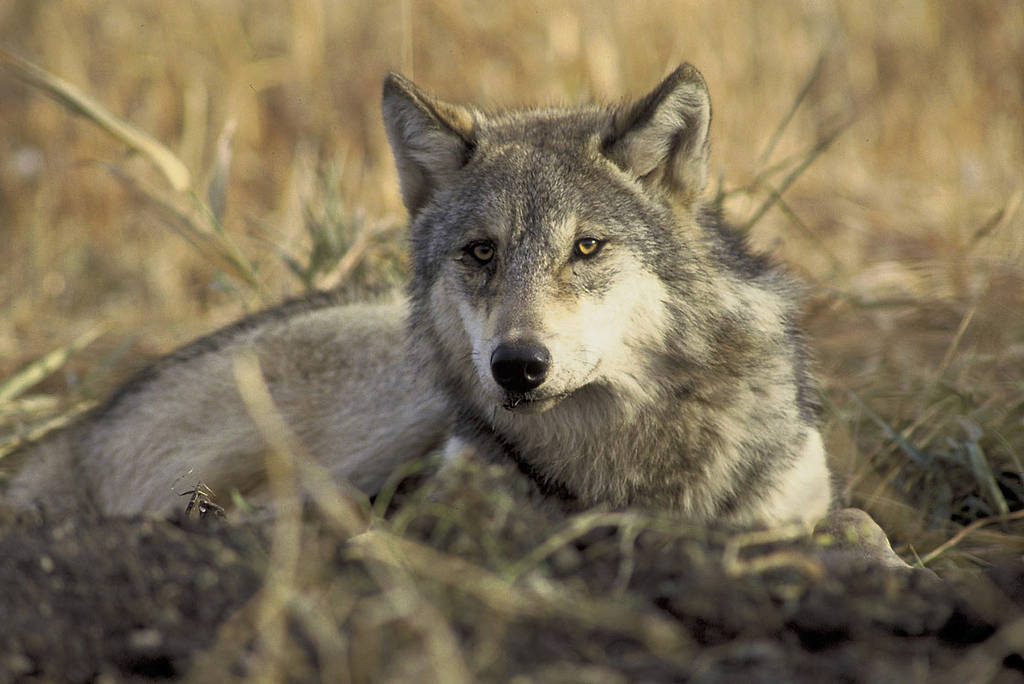
California’s 3 million dollar pilot program to reimburse ranchers when endangered gray wolves kill their livestock aims to strike a balance between conservation and ranching interests. It has largely been a success, but KQED’s Alix Soliman reports its future is unknown.
***
Gray wolves, once common here, have trekked from other states into northern California where Richard Egan runs 400 cattle south of Susanville on hundreds of thousands of acres.
The expansive range, where the Lassen Wolf Pack roams, means he might not find a dead cow for days, or at all.
“bears consume whatever is not immediately consumed by the wolves in about 24 to 36 hours.”
This makes it difficult to say whether wolves were responsible. The California Department of Fish and Wildlife, which runs the program, has confirmed wolves have killed 5 of Egan’s cows.
“And we’ve probably had, at my estimation, six or seven times that number that were killed by wolves but not confirmed.”
He says that the amount he’s reimbursed… about three thousand dollars per death … doesn’t cover the total loss … but he believes the pilot should continue with improvements.
It’s meant to deter wolves from hunting farm animals and to pay when the predators inevitably kill livestock. Ranchers have submitted 102 claims and the department has verified 18 wolf kills.
Now, money is running out. Jordan Traverso, spokesperson at the department:
“So we have no commitment at this point that the funds are going to continue, but I do know that a lot of livestock producers would like to see that happen. And it looks like our wolf population is growing, so somewhere along the lines those two things are going to have to reconcile.”
Amaroq Weiss [[Ahmah-rook Whyss]], with the Center for Biological Diversity, says the program is a basis for livestock owners to coexist with gray wolves.
“It is so rare that you have an animal that we once tried to wipe from the face of the earth begin to return to a place all on its own.”
Wildlife officials are evaluating the program. The state will decide whether – and how – it will continue.
For The California Report, I’m Alix Soliman.
Photo courtesy of USFWS.
 ALIX SOLIMAN