
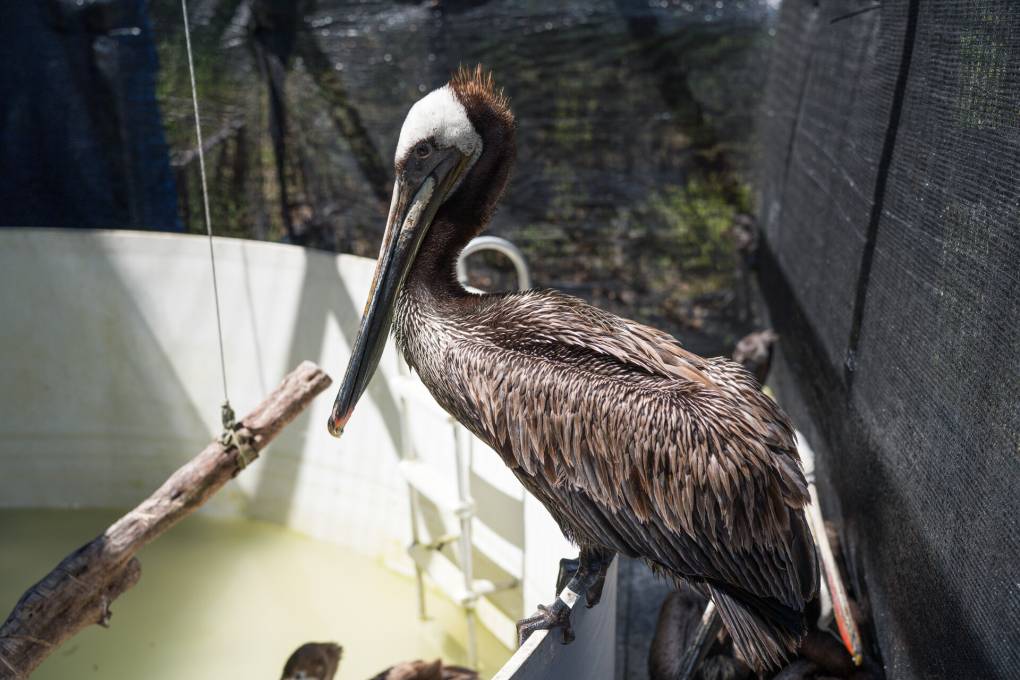
Brown pelicans are starving up and down the California coast. Monterey Bay is a particular hot spot. A wildlife rescue center there has taken in more than a hundred emaciated birds over the past month … state officials and researchers aren’t certain why.
KQED’s Alix Soliman joined volunteers on a rescue mission at Asilomar State Beach:
***
[[Engineer fade up ambi of walking to rescue and play underneath this opening scene]]
Nancy Cunningham crouches on the rocks and places a plaid bed sheet over the white head of a pelican.
Cunningham: “Ok bud, let’s see if we can help you.”
She’s a volunteer for a local animal shelter. Her colleague, Philip Johnson, scoops the bird up.
Johnson: “you got his feet? You got your blanket? … Good deal”
Cunningham: “gotta keep him warm…”]]
They are here after a report of the pelican drooping his beak into a tidepool
Johnson places him in a dog crate in the back of the truck before getting in the cab.
[[truck door closing, seatbelt click]]
Cunningham: poor peli
Johnson: “he’s in pretty rough shape
Cunningham: “yeah he is, isn’t he”
[[fade up sound of truck driving ambi]]
A short drive and they’re back at the SPCA in Monterey County. They pull up and take out the crate.
The bird’s eyes are open, but its head is cocked to one side. It is motionless.
“unfortunately the pelican did not make it home.”
This is one of hundreds of starving brown pelicans washing ashore. So far, the California Department of Fish and Wildlife isn’t totally sure what happened to them.
The agency’s Tim Daly says the state’s working hypothesis is that this situation … and a similar one that happened in 2022 … were likely caused by late spring storms.
“the waters were incredibly choppy, it was very windy, visibility was poor — and our strongest belief at this point is that the pelicans were simply having trouble reaching the fish that were below the surface.”
He says there are plenty of anchovies and other fish. The pelicans just can’t see them in the murky water.
Rebecca Duerr [Doo-er] directs research at International Bird Rescue. She says that explanation makes sense, especially since they’ve ruled out avian flu as a possible cause.
“Certainly the visibility and catchability of fish can be an issue for them, ‘cause they don’t dive very deep — even the biggest brown pelican can only grab fish about six feet deep.”
Duerr says the birds — which were taken off of the endangered species list in 2009 — are worth the rescue effort. They have a great survival rate after they’re released … and can live to be around 40 years old.
[[fade in ambi of pelicans flapping their wings in the enclosure ]]
It’s feeding time for the pelicans back at the SPCA in Monterey.
The scraggly birds flap their wings, preen their feathers, clack their beaks, and dip in pools.
Dani Fowles [Danny Fahwls] is a wildlife technician here. She’s stuffing multi-vitamins for the pelicans into the mouths of dead fish.
“Instead of manhandling all of them, we’re trying to put them in fish because we know they’re hungry.”
Tossing the fish into gaping beaks, she and another wildlife technician Cory Utter notice one pelican shivering.
[[Engineer note: you might need to turn up the volume on these last bites]]
Sounds of them catching the pelican
Utter: I think he’s probably cold
They catch him and place him in an indoor warming room, with other birds struggling to regulate their body temperature.
Once the pelican warms up, Utter takes a blood sample from his foot. The pelican gurgles.
“When they sound like that we’re typically starting them on antibiotics just because the chance of pneumonia is pretty high”
Utter says they likely aren’t saving all the pelicans, because most people can’t tell if a bird is struggling. There is one sure sign, though:
“If you can walk right up to it and it doesn’t seem bothered by you, then there’s probably something wrong.”
If that happens, officials say to call your local wildlife center.
Once the birds are well enough to travel, they go to the International Bird Rescue center in Fairfield for rehabilitation.
For the California Report, I’m Alix Soliman at Asilomar State beach.

 ALIX SOLIMAN