
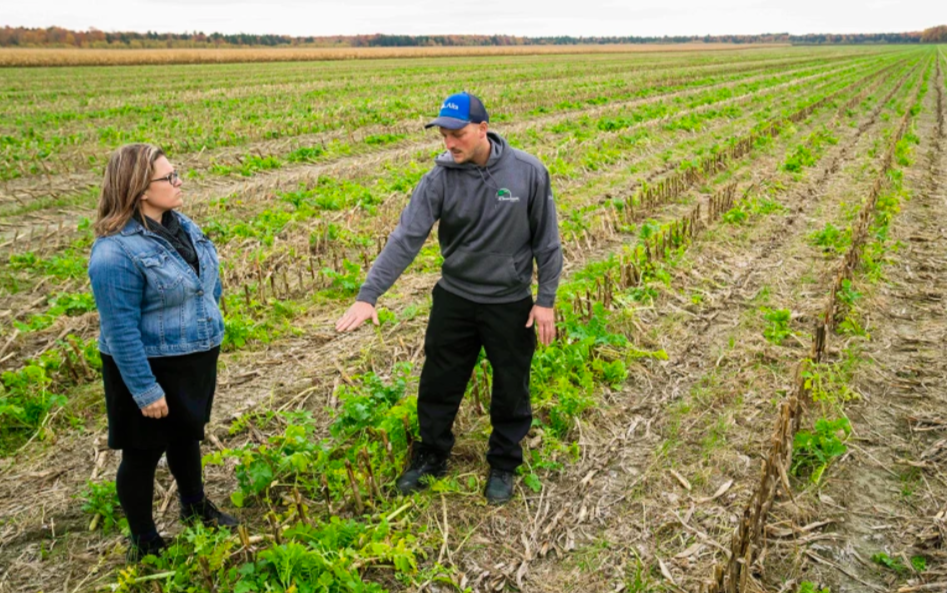
Featured image: Agronomists examine a field where the cash crop, maize, has been harvested and a cover crop, radishes, has been planted to protect soil health. Credit: Paul Chiasson/The Canadian Press/Alamy
As climate change threatens farmers’ ability to produce the world’s food, researchers and environmental advocates think they have a solution: playing in the dirt.
Experimental evidence is accumulating, they say, that by improving soil health, crops can be made more resilient to drought and extreme weather — and they want governments to offer financial incentives to farmers who use ‘regenerative’ practices to climate-proof farmland. These agricultural practices include boosting the soil microbiome — that is, its microbial community — by rotating crops between fields, rather than adding ‘cover crops’ to fields. These comprise plants that won’t necessarily be harvested, but that prevent soil erosion and boost soil nutrients.
 ALIX SOLIMAN